How a superego emerges
It’s May 1, 1999 — Labor Day in Belarus. I’m five years old, holding my grandma’s hand, heading to the market. Her hand felt like a big warm leather bag covered in a layer of parchment paper. At that age I expressed barely any revolt against the layers of clothing I was dressed in, but I do recall the discomfort caused by the tights, hats, and mittens. Was I really wearing all that on May 1? Unlikely, though not impossible.
That said, even the five-year-old me understood that it was a bit cold for May.
The way to the market was long—ten minutes on foot.
Have you tried counting to sixty, ten times in a row, at age five?
I remember when my grandma’s friends came over for tea: I would get frustrated when they excluded me from the conversation. It was either babushka Galya or tyotya Natasha who always asked for ten more minutes. They expected me to do kid stuff: “Play with your Legos,” “Why don’t you draw something in your album?” “You showed us your play-doh figures last time—maybe go make some new ones?”
I didn’t yield to their trivial prompts—unconvincing even to a five-year-old. I grabbed a wristwatch and timed the full ten minutes.
As my gaze tracked the watch hands, I grew unmoored from observing the actual passage of time.
“Ten minutes are up!” I exclaimed.
“Give us some more time, Seryozha, will you?” was their reply. The answer I would not stand for.
“What do you mean?! You said ten minutes! Ten minutes are up! It’s my turn now!”
The babushkas tried to carry on talking as if I was nothing but a pesky fly annoyingly orbiting their heads. I wouldn’t stop, persistently butting into their talk, demanding they honor the agreement. Finally, they gave in. I could converse.
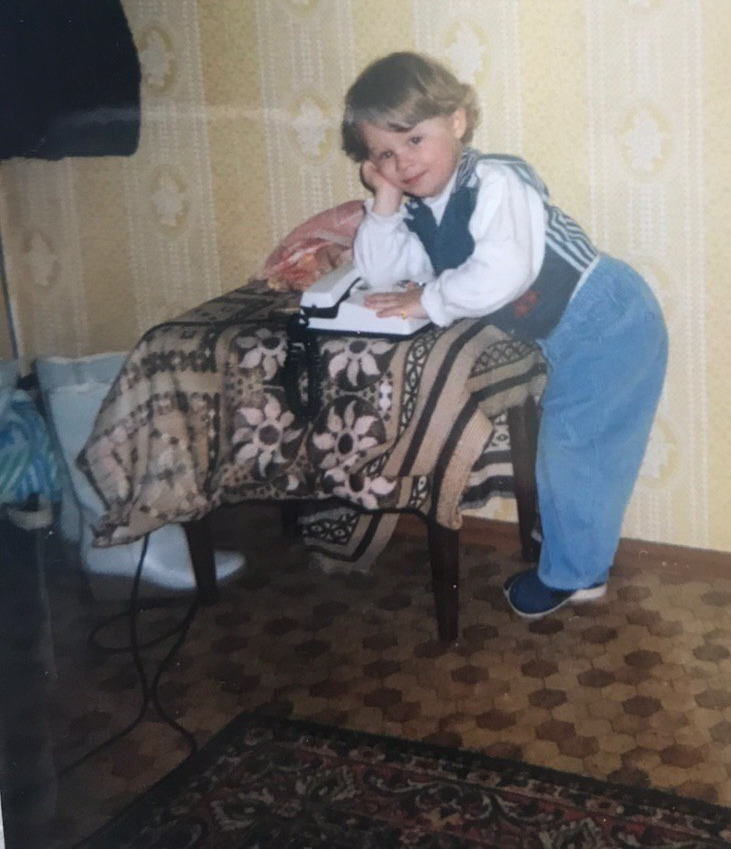
There was one conversational partner who always had time to listen to my stories—but only during the summer.
When June came around, I would spend most of my time with my grandparents at our dacha. My mom had to work, so I got to see her only on weekends.
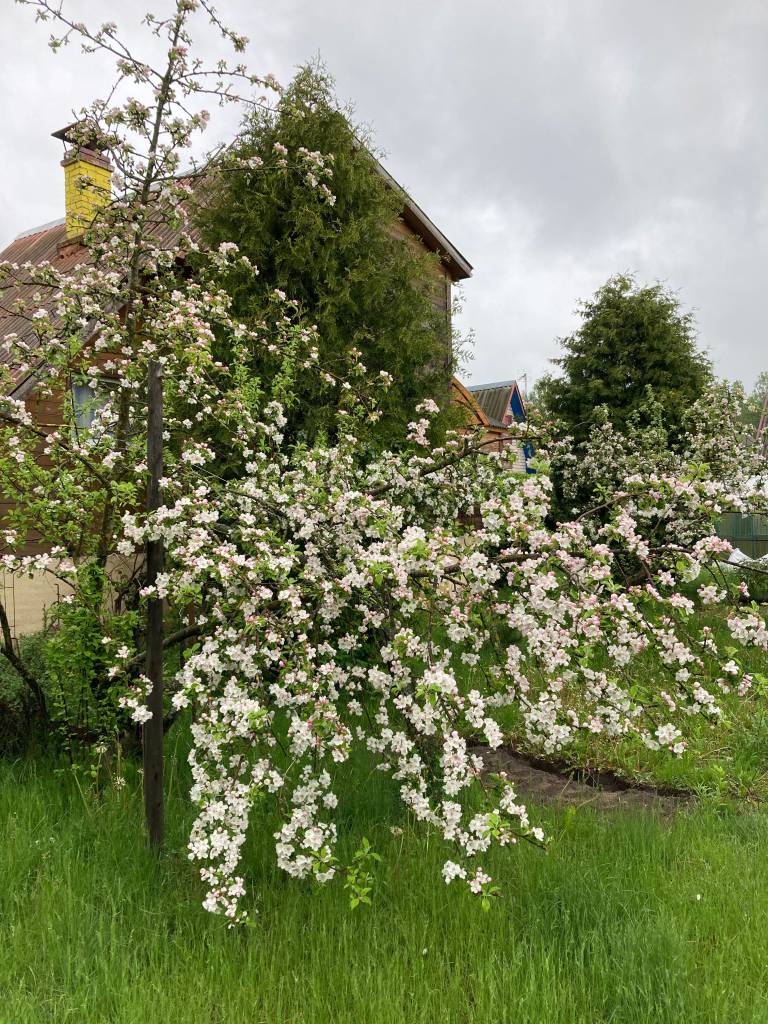
I was having a blast: so many bugs, creepy crawlies, plants, and smells. There were a bunch of neighbor kids of various ages, but I was taught not to get too friendly with them. We would ride bikes, go to the communal field, play ball—always busy. When I got tired from being a kid, I could always visit babushka Valya—a kind old lady whose dacha was right across the street.
I wasn’t particularly good at keeping time as a preschooler. Days in June are endless, evenings long. Conversations with babushka Valya went on for hours—until the brightness of the day subsided, mosquitoes grew eager to feast, and the scent of moist grass rolled in from the field.
We took breaks. I would run off to cater to less important matters, then come back, picking up where we left off. I was exceptionally good at remembering the cliffhangers.
I brought her candies and cookies that I got from my grandma. Sometimes grandma would join us, but very quickly I got jealous. Babushka Valya’s attention was MINE!
It was nice of grandma to let babushka Valya and me wrap up the conversation in private—something I couldn’t appreciate back then. Only now, as I excavate these memories, do I notice the tiny courteous gestures adults made.
Adults shape the weather of childhood.
The bad is hard to miss, though, and I made sure to get mad at grandma whenever she made me come home with her.
It took me almost three decades to understand that she allowed me to experience the joy of private adult conversation. Knowing my grandmother, it’s most certainly accidental—she would never back away out of goodwill alone. But I choose to believe that she did:
then and many times after.
There’s no way to verify this, but I sometimes hypothesize: grandma could have let me stay out of spite. Maybe she was cross with babushka Valya and thus had me be the irritant. I was merely speaking the way a kid speaks—circling the exact same motif, regurgitating a single story, stacking adjectives—training.
I was using babushka Valya as a practice audience; my grandma was using me as a weapon to “deliver a message.” And babushka Valya was
a nice old lady.
Old ladies offered amazing ears for my embarrassing speeches, but I needed a different kind of audience for my superego to truly blossom.
It was some five hundred days later—November 2000.
My mother and I are in the living room of my godfather’s apartment.
Besides us two, there were fifteen people or so. I don’t recall any kids my age—just people at least several years older than me.
People are giving toasts and raising glasses to the host—it’s his birthday.
I whisper to my mom, “How old is he?” She leans in and whispers back, “Forty,” in a tone that I’ve since come to interpret as: Others can hear us. This is awkward. We’d better make it quick or avoid it altogether.
Understood.
I raise my glass to make a toast. The audience is silent. Prepared. A seven-year-old begins the delivery:
“Dear godfather! I congratulate you on your birthday! On this day I wish goodness not only upon you, but also upon your family and all those present today at this table!”
Standing ovation. Clinking glasses.
It wasn’t the first time I’d made a toast at a get-together, but it was certainly the most potent delivery yet. I was exhilarated—the adults genuinely impressed. Even years later, whenever my mother recalled this event, she would mention how highly the guests spoke of me.
It was so good that I needed more.
The guests ate, drank, and played. They grew loud and curious. Subconsciously, I felt it was the right time to get another “hit.”
I stood up, raised my soda-filled glass, and began garnering attention.
Some guests noticed and quieted down; others kept on with their conversations. I said something along the lines of “Dear guests!” and “I’d like to make a toast to the host…” but many ignored me. That was uncomfortable.
The collective effort of the curious eventually compelled the rest to quiet down and listen. What does the kid have in store this time?
Not much.
I hit them with roughly the same toast as before, save for an added layer: “May not only those present here today have goodness borne upon them, but also everyone in Minsk and the whole country!”
The crowd cheered. Some women found it a touchingly sweet addition to my original toast, but the overall reaction had dimmed.
I felt that.
Was there something wrong with what I said? Was it the way I said it?
This repeated a few more times.
With each toast I wished goodness upon a larger “audience”: first, guests at the table; then, fellow countrymen; then, the planet; and finally, the universe.
“What an idiot I was,” I thought to myself in the aftermath. “I should’ve stopped at ‘people of Belarus.’”
Embarrassing.
My superego finally ripe. It was my own reflection in the guests’ eyes that I saw and
I no longer just felt;
I now understood.
Five hundred days before that, I understood less—but enough to know that it was a bit cold for May.
As grandma and I passed through the market gates, I saw little mounds of snow in the shade. I frequently bring up this image in conversations about climate change, childhood, and core memories.
My godfather’s fortieth birthday. Endless 90s summers. Grandma’s clique.
I don’t remember snow in Minsk at this time of year before or since. And if I did…
Would the other memories still be there?
Did I ever talk to babushka Valya about the snow mounds in the shade at the market on Labor Day?
 Юревич. Yurevich.